
SEO + GEO : The Perfect Guide for Your Business
How to combine traditional search engine optimization (SEO) with AI-driven search optimization (GEO) to ensure your business is visible, cited, and discoverable — locally and beyond.
Why this article matters
You have a great website, solid LinkedIn posts, and you invest in campaigns… yet the calls are slow, and conversions aren’t growing the way they should.
Often, the problem isn’t a lack of effort — it’s a visibility strategy that isn’t evolving as quickly as modern search engines (SEO – Search Engine Optimization) and now AI-powered engines (GEO – Generative Engine Optimization).
The goal of this article is to give you a clear, concrete, step-by-step guide to mastering both SEO and GEO — and making them work together.
Whether you’re a service-based business, a growing brand, or a B2B organization, your online visibility now determines the strength of your brand.
Understanding the Difference: SEO vs GEO
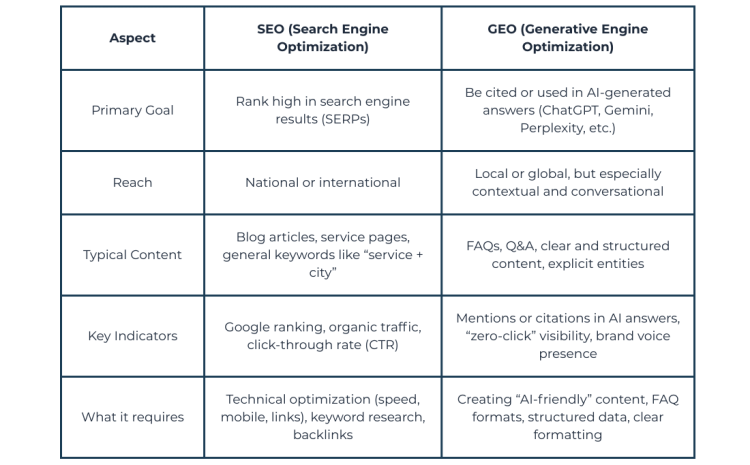
In summary: SEO puts you on the map; GEO puts you in the answer.
And for brands, it’s a major opportunity to build a conversational presence: When a user asks an AI engine “Which brand offers the best sustainable products?”, the answer comes from content already available online — ideally yours.
Why Combining Both is Non-Negotiable
SEO alone: You may be visible, but not cited by AI search engines.
GEO alone: You may get occasional mentions, but without SEO foundations, you lack credibility and traffic.
Together: You cover both traditional search + AI search. This maximizes your chances of being found and cited.
Example: A service business in Vancouver might get solid SEO traffic but never appear in AI-generated local recommendations — causing it to miss “immediate-intent” searches.
Common Mistakes to Avoid
These are a few mistakes we listed in our previous article — and how they apply here:
Mistake: Focusing only on your website without considering how AI engines read it.
→ Without clear structure, FAQs, or schema markup, your content isn’t machine-readable — meaning it’s rarely selected as an “answer-ready” source.
Mistake: Ignoring customer reviews.
→ For SEO, reviews affect trust and authority. For GEO, they strengthen your E-E-A-T signals (Experience, Expertise, Authority, Trust), which AI tools rely on.
Mistake: Generic content without localization.
→ Do you use “service + city”? Is it actually visible in your content? Can AI tools detect it?
Practical Guide – How to Improve Your SEO & SEO Starting Now
Here is a concrete action plan you can apply immediately.
Step 1: Optimize Your Local Presence (GEO + SEO)
- Complete your Google Business Profile (name, address, phone, hours, service descriptions including “service + city”).
- Add recent photos and encourage customer reviews — and respond to them.
- Create “service + city” pages on your site (e.g., “IT Support in Port Coquitlam”).
- Use local keywords in your titles, meta descriptions, and on-page content.
Step 2: Produce “AI-Ready” Content (GEO)
- Create FAQ-style articles with natural questions:
- “How do I choose an SEO expert in Québec?”
- “What makes a good LinkedIn service for small businesses in Vancouver?”
- Structure your content: clear title (H1), subtitles (H2/H3), bullet points, tables. AI engines read this better.
- Add structured data: FAQPage, HowTo, LocalBusiness — this helps AI interpret your content.
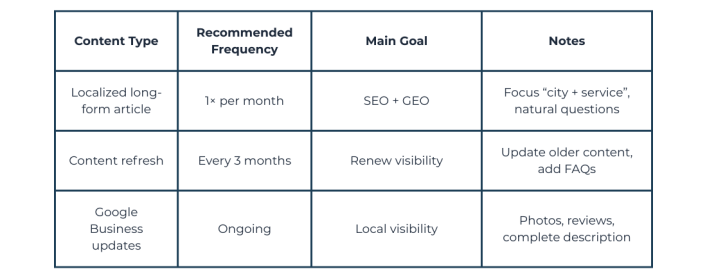
- Recommended frequency: publish 1 localized long-form article per month; refresh older ones every 3 months.
- Expand your presence across channels (socials, forums, partnerships); AI tools evaluate external signals too.
Step 3: Strengthen Your Technical and Content SEO
- Ensure your site is fast, mobile-friendly, secure (HTTPS), and well internally linked.
- Perform keyword research: include both general and local keywords (“LinkedIn marketing”, “LinkedIn marketing Montréal”).
- Produce high-quality content with meaningful depth; secure backlinks from reputable sites.
- Track metrics: ranking, traffic, conversion rate — and for GEO, brand mentions/citations in AI outputs.
Step 4: Measure and Adjust
- For SEO: Monitor Google Search Console, analytics, keyword ranking.
- For GEO: Check where your brand is cited within AI responses. Track your visibility in Google’s AI Overviews or any AI-powered snippets.
- Update your strategy every 3–6 months based on data.
For product-based brands:
- Optimize your “Where to Find Us” page and local product listings (Google Merchant, Local Pack inclusion).
- Publish articles or FAQs about your ingredients, sourcing, or sustainability — AI engines reuse this data in responses.
- Encourage media mentions, partnerships, and backlinks — domain authority influences how AI models trust your content.
Content Frequency & Types
Real Examples
Example 1 — Local cleaning company in Vancouver added a “Commercial Cleaning Vancouver Eastside” page, published an FAQ article “How to choose a commercial cleaning service in Port Coquitlam?”, and gathered 30 new reviews in 3 months. ➡ Result: +40% calls from Google Maps.
Example 2 — B2B marketing firm rebuilt their blog around conversational questions: “Why invest in LinkedIn for small businesses?”, “How do you measure LinkedIn ROI?” and added FAQ schema markup. ➡ Result: Cited in Google’s AI Overview + 25% organic traffic increase.
Example 3 — Canadian food brand created a series of blog posts and FAQs around local ingredients (“Where to find our products in Québec?”, “Why choose Canadian-made snacks?”). ➡ Result: Cited by AI assistants when users searched for “healthy snacks made in Canada.”
These examples show that company size doesn’t matter — the combined SEO + GEO strategy does.
Conclusion
Search is changing. More and more, users get instant answers through AI — without ever clicking a link. This changes the rules completely.
Whether you’re a small service business or a fast-growing brand, your customers are actively looking for answers — and AI engines are looking for reliable sources to provide them.
By combining SEO and GEO, you turn your content into a long-term asset — something that works for you even when you’re not publishing.
If you’re looking for:
- a local visibility audit
- a content plan optimized for SEO + GEO
- a LinkedIn or social strategy to amplify your reach
We’d be happy to help you go from strategy to action.
Bonus – Educational Toolkit: Mini GEO Checklist
✔ Do you have a “service + city” page?
✔ Does your content contain natural questions your clients ask?
✔ Are you using FAQ or HowTo schema markup?
✔ Is your Google Business Profile complete and active?
✔ Have you planned one localized article this month and one content refresh every 3 months?